
The Art of Medicine: Sculpture at the British Institute of Radiology
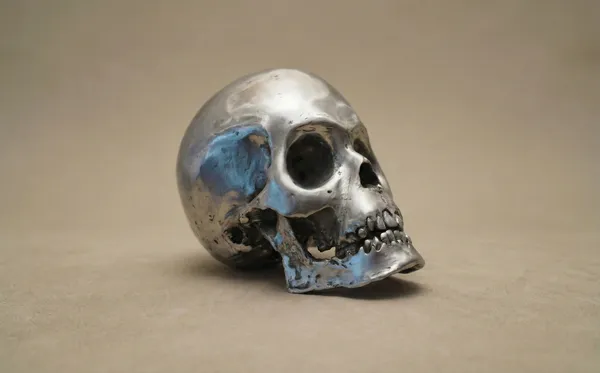
“A 2009 exhibition at the British Institute of Radiology exploring art and anatomy, featuring steel sculptures by Julian Warren curated by Prof. Paul Goddard.”
The Art of Medicine: Sculpture at the British Institute of Radiology
On 17th March 2009, the British Institute of Radiology (BIR) hosted The Art of Medicine, an exhibition that explored the uneasy, fascinating boundary between science, anatomy, and imagination. Curated by Professor Paul Goddard, the exhibition brought together works that challenged how we see the body - not just as a biological structure, but as a site of meaning, vulnerability, and transformation.
I was invited to take part by Paul, a good friend and an insightful curator, whose vision for the exhibition was rooted in dialogue: between artists and clinicians, aesthetics and diagnostics, mortality and hope.
Steel, Anatomy, and Origins
One of my exhibited works was a stainless steel human skull, polished to a near-clinical finish and presented resting atop a copy of On the Origin of Species. The pairing was deliberate. The skull - an object that universally signifies mortality - sat upon a text that radically reshaped our understanding of life itself.
The reflective surface of the steel echoed the medical environment: surgical instruments, operating theatres, imaging equipment. At the same time, its placement invited viewers to consider evolution not as an abstract theory, but as something written into bone, into form, into the very structure of our heads.
Hope: The Scorpion and the Syringe
Also featured was "Hope", a scorpion sculpture. At first glance, it appears defensive, even threatening - a creature synonymous with venom and danger. But closer inspection reveals a transformation: the scorpion's telson morphs into a long, syringe-like needle.
This ambiguity was central to the piece. The syringe can heal or harm. Medicine itself carries risk as well as relief. Hope sits in that tension, asking whether fear and cure are sometimes indistinguishable, depending on perspective.
Fragmentation and the Body
Two further works addressed the idea of bodily disruption and reconstruction.
The Skeleton Jabberwocky sculpture played with hybridisation - part myth, part anatomy ' referencing how medicine often navigates the unfamiliar, the monstrous, and the misunderstood in its pursuit of knowledge.
Alongside it, a human mask sculpture, broken into sectional fragments of the face, evoked both medical imaging and psychological fracture. It suggested the way the body is often reduced to parts: scans, slices, diagnoses - while the person behind the face risks being lost in the process.
Art in a Clinical Space
Exhibited within the setting of the British Institute of Radiology, these works took on added resonance. Surrounded by professionals whose daily work involves imaging the unseen interior of the body, the sculptures functioned less as objects and more as prompts for reflection.
As noted in contemporary coverage of the exhibition, including a review by Matt Brown, The Art of Medicine succeeded in unsettling easy distinctions between art and science, discomfort and curiosity, aesthetics and ethics.
Looking Back
The exhibition remains a significant moment in my practice. It reinforced my interest in medical symbolism, evolutionary thought, and the material language of steel as a stand-in for both resilience and cold precision.
Above all, it demonstrated how art can inhabit scientific spaces not as decoration, but as an active participant in questioning how we understand the human condition.